 Thanks to the wonderful Hoffer family, who came to visit Egypt with their daughter Izzy, two other NSLI-Y students and I were able to accompany them to Dahshur and Saqqara.
These sites contain the oldest pyramids in the world, but they are not as popular with tourists because they are harder to access because they're located south of Giza on a more rural route. However, the Hoffers hired a van for all of us, which made the entire visit so much easier because we didn't have to worry about finding taxis or walking the long distances in between sites. The driver would also tell the security guard at the gate that his passengers were Swedish because he told us that if the guards knew we were from the U.S., we would have to be escorted through the site for security reasons. The rationale is that if anything were to happen to us as tourists, the US government would most likely get involved and it would cause a huge problem, whereas the European governments would probably not make as big a deal out of it.
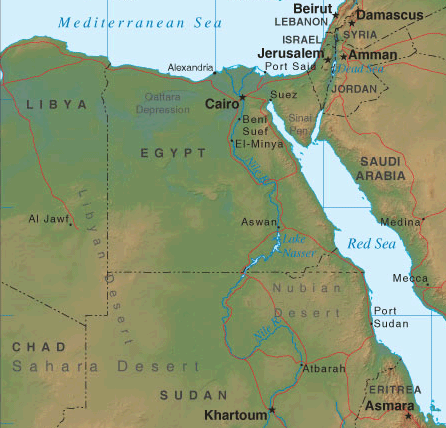
We got an early start from Cairo and didn't return until mid-afternoon, and luckily the weather wasn't too hot because the pyramids are in the middle of the desert.  We drove through some rural-looking villages, one of which was Memphis, which used to be the impressive capital of the Old Kingdom but is now a very poor village. (picture: the Hoffer family descending from the Red Pyramid after going inside).
 We drove through some rural-looking villages, one of which was Memphis, which used to be the impressive capital of the Old Kingdom but is now a very poor village. (picture: the Hoffer family descending from the Red Pyramid after going inside).
We visited Dahshur first, which is most known for the Red Pyramid and the Bent Pyramid, both built by Snofru during the Old Kingdom (~2600 BC). We went inside the Red Pyramid, which was exciting, but it was COMPLETELY dark inside (we had to use the flashlights on our phones), the climb down inside was very cramped, and it smelled terrible.  The Red Pyramid's name originates from the red color of its outer limestone casing which is now gone. (picture: descent into the Red Pyramid).
 The Red Pyramid's name originates from the red color of its outer limestone casing which is now gone. (picture: descent into the Red Pyramid).
We drove to the Bent Pyramid, which is on the same site but located across a few sand dunes from the Red Pyramid. The most remarkable part about this pyramid is its 'bent' shape - the base of the pyramid rises at a steep angle and then  partway up the slope decreases, giving the overall pyramid a curved shape. Most of the limestone casing is still in place, which also makes it an impressive site. We wandered around the pyramid a little, and I read the information about it from my Rough Guides book. (pictures: all the kids in front of the Bent Pyramid; the Bent Pyramid looking from the Red Pyramid).
 partway up the slope decreases, giving the overall pyramid a curved shape. Most of the limestone casing is still in place, which also makes it an impressive site. We wandered around the pyramid a little, and I read the information about it from my Rough Guides book. (pictures: all the kids in front of the Bent Pyramid; the Bent Pyramid looking from the Red Pyramid).
After leaving Dahshur, we made our way to Saqqara, which was where the pharaoh's and nobility of the Old Kingdom were buried (c. 2600-2100 BC). It is the largest archeological site in Egypt, although much of it is still unexcavated, and we only visited the northern part. The highlight of North Saqqara is the Step Pyramid, which was designed by Imhotep for Pharoah Zoser - Imhotep is credited with initiating the pyramid-building phase in Egypt.  We explored the ruins surrounding the pyramid as well, and visited the neighboring Pyramid of Teti, whose outer appearance was basically a loose pile of rocks, but the inside was amazing! (picture: the Step Pyramid)
 We explored the ruins surrounding the pyramid as well, and visited the neighboring Pyramid of Teti, whose outer appearance was basically a loose pile of rocks, but the inside was amazing! (picture: the Step Pyramid)
The descent down was much more comfortable, the lights were illuminated, there was no suffocating stench,  and the wall carvings were impressive. We also went in one of the many mastabas, which were the burial places of nobility, and the wall reliefs were really breathtaking because they were so well preserved, extremely intricate, and stretched from floor to ceiling. (picture: a view of hieroglypics inside the Teti Pyramid).
 and the wall carvings were impressive. We also went in one of the many mastabas, which were the burial places of nobility, and the wall reliefs were really breathtaking because they were so well preserved, extremely intricate, and stretched from floor to ceiling. (picture: a view of hieroglypics inside the Teti Pyramid).
The site is much larger, but many of the other places were closed  and we were happy with what we'd seen, so we headed back to Cairo and hung out for a couple more hours until we finally had to say goodbye to Izzy and her family - a very sad occasion, to say the least. (picture: drinking juice - I have a fruit cocktail and Izzy has mango - together, moments before saying goodbye).
 and we were happy with what we'd seen, so we headed back to Cairo and hung out for a couple more hours until we finally had to say goodbye to Izzy and her family - a very sad occasion, to say the least. (picture: drinking juice - I have a fruit cocktail and Izzy has mango - together, moments before saying goodbye).
Although the Giza Pyramid site is spectacular because of the proximity of the pyramids to each other as well as their sheer size, Dahshur and Saqqara were much more interesting (and a lot less crowded)!
Happy (early) Easter, and Happy Birthday, Grandma. I love you and miss you all!
Thank you, again, the Hoffer Family!


No comments:
Post a Comment